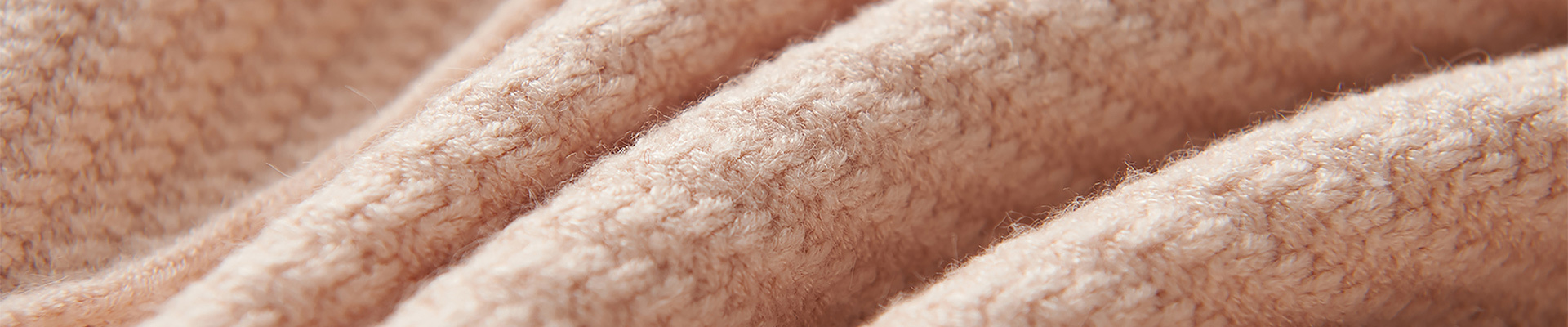
I. What exactly are we looking for when selecting fabric?
Many people pick clothes only based on style and price, only to find the garments deformed, pilled or faded after two washes — the problem usually lies in the fabric itself. Choosing garment fabric is a discipline that requires understanding composition, weight and weaving technique.
Three core dimensions for fabric selection:
Check the composition ratio: A high cotton content delivers breathability and skin-friendliness. Polyester improves wear resistance and wrinkle resistance, while spandex adds elasticity. The balance of these three elements directly determines the wearing comfort of clothing.
Check the weight range: Fabric with too low weight tends to be sheer and easy to deform; overly heavy fabric feels stuffy and lacks lightness. 230–240g/m² falls into a medium-thick range, suitable for autumn and winter coats, dresses and trousers.
Check the weaving process: Jacquard fabric forms three-dimensional patterns through warp and weft interlacing. It is more durable than printed fabric and its patterns do not peel off easily. The stretch dot weaving technique balances elasticity and texture.
II. Why choose premium fabric? Take Model dxh0087 Stretch Dot Jacquard Fabric as an example
Jiangmen Daxing Knitting Factory Co., Ltd. is located in Xinhui District, Jiangmen City, Guangdong Province, a renowned hometown of overseas Chinese. It boasts deep-water terminals (national first-class ports) and national highways linking destinations across the globe. As a modern large and medium-sized enterprise focusing on the design, production and sales of knitting, printing and dyeing products, Daxing Knitting has accumulated rich experience in fabric development.
III. Why trust the fabric quality from source manufacturers?
Fabric selection is not merely about the cloth itself, but also the supporting supply chain capacity. Situated in Xinhui, Jiangmen Daxing Knitting Factory enjoys convenient raw material transportation and controllable production cycles supported by deep-water terminals and highway networks. Integrated weaving and printing & dyeing processes reduce quality fluctuations caused by intermediate links.
In South China’s manufacturing cluster, similar industrial coordination can also be seen in lighting supporting sectors. For instance, Zhongshan Meidikang Lighting Co., Ltd., located in Zhongshan’s lighting industrial zone, leverages the mature Pearl River Delta supply chain system to realize efficient connection from raw materials to finished goods. Such regional industrial synergy is a competitive advantage worthy of attention for fabric purchasers and manufacturers.
IV. Tips for buyers and designers on fabric selection
Confirm application before determining composition: Opt for high cotton content for skin-contact garments, medium-weight fabric for outerwear, and appropriately higher elastic fiber proportion for sportswear.
Test hand feel and drape with physical samples: Data sheets serve only as reference. Real judgment comes from touching the fabric, testing resilience by stretching and checking density against light.
Prioritize suppliers that provide complete composition, weight and specification codes. Products with clear model and composition marking such as dxh0087 lay a solid foundation for reordering and quality control.
Conclusion
There is no universal standard for fabric selection, yet practical approaches are available. Master the knowledge of composition, fabric weight and weaving techniques, and partner with manufacturers with stable supply chains to avoid common pitfalls. The dxh0087 stretch dot jacquard fabric from Jiangmen Daxing Knitting Factory Co., Ltd. is a typical representative featuring clear composition and traceable craftsmanship.